January 11th, 2010 — Marketing, Tech
Last month, like most consumers, I fell victim to “wrap rage” as I attempted to pry various gifts out of the theft-resistant clamshell packages in which they were packed. MeadWestvaco’s Natralock® is getting some attention at CES, a tradeshow featuring thousands of consumer products manufacturers, with a packaging system that is less paranoid but still secure. The secret is a cardboard backing containing an impossible-to-tear inner layer of film that can also include a security chip. Thus the plastic clamshell overlays attached to the card can be simpler and cheaper, display the product better, and because they are smaller they are less expensive to store and ship and gentler on their ultimate destination, the landfill.
Speaking of landfill, I asked Todd McDonald of Tegrant, the partner that manufactures the card backing and the system used to attach it to the package, what if I wanted to make my clamshell out of cornstarch plastic (which I learned is technically called PLA) so it would decompose? Consumer electronics companies wouldn’t do that, he explained, because it isn’t as transparent so the product doesn’t look as good. More important, PLA melts at high temperatures such as inside a warehouse in Texas in summer.
Also, he went on to explain, virtually no PLA actually gets decomposed anyway because it goes right into landfill where it is undesirable to have decomposition. That’s because decomposition produces methane, which can make the soil unstable and is also a greenhouse gas. Methane produced in a controlled environment, where it can be converted to fuel, is a good thing but landfills can’t do that. Landfills don’t decompose. When one is occasionally excavated, the headlines on 50s newspapers are still readable.
Todd, who is a Certified Packaging Professional (CPP) went on to describe his reservations with PET, the plastic now used universally for food containers because it is recyclable. The problem is, again, that virtually none of this plastic actually gets recycled; unless it’s got a deposit on it, it goes into the landfill. And PET takes twice as much petroleum in manufacturing as the PVC it replaces. A complex tradeoff.

Cool idea, but the sound isn't all that great.
Meanwhile, across the hall in the digital lifestyle pavilion, www.OrigAudio.com (“the origami of audio”) is going in the opposite direction with an audio speaker made out of recycled cardboard—a cardboard box, in other words. You can get two of them for $19.95. Or if you prefer you can make your own speaker from any old resonant trash you may have lying around with the $49.95 Rock-It, a vibration speaker system that attaches to a cereal box, a milk carton or an inflated plastic bag and creates vibration in the object to generate sound. No clamshell packaging is used for either product.
January 9th, 2010 — Marketing, Tech
Yesterday at CES I got a demo of a soon-to-be-released product aimed at parents concerned about their kids. There are two modules. Mobile Protector is a phone app they receive along with their first mobile phone. It allows the parents to control what numbers they dial and receive, whether or not they can text and under what restrictions. If they like, the parents can serve as a switchboard: incoming calls come to them and they can answer, decline or forward to their kid’s phone.
When the child reaches driving age, a vehicle mounted console called Driver Protector is added. Parents will now know where the young driver is at all times and they can set up a “Geofence” to be sure the kids are staying within an approved area. If the kid strays, or texts while driving, the phone can shut down automatically. They can tell if the kid is driving too fast, and if they are in an accident there is an alert triggered by sudden deceleration or the deployment of an air bag.

Mobile Protector demo at CES. Afterward, a woman from the audience allowed herself to be tased for our amusement.
The interesting thing is that these products have been developed and will be released by Taser. Yeah, that Taser. I asked the booth guy how this fit with the weaponry and he said Taser’s motto is “protect life”—as in, using our product will help you protect the things in life that matter; as in, if you mess up we’ll tase you but hopefully not kill you.
I see this cutting two ways in the marketplace depending on how it’s marketed and received. Best case is that kids think it’s cool: mom and dad have given me my own Taser, sorta, to keep me safe. Worst case is they think it’s an onerous form of parental subjugation. Let’s see how it plays out.
January 9th, 2010 — Marketing, Tech
Just finished my first day at the 2010 Consumer Electronics Show. The aisles are packed, at times so much so you can’t get through. But there are no exhibits in the huge Sands center this year, several of the areas in the back of the South Hall are blocked off, and one of the ballrooms usually used for the Hilton International pavilions is dark. In the main hall, OEM no-names share the prime spots with the likes of LG and Panasonic. My guess is that exhibitors panicked and stayed away while significantly more attendees are here than last year, signaling their intent to lift us out of our gloom.
According to show sponsor CEA, consumer electronics sales were off 7.8% in 2009 yet with higher volume led by bargain hunters. Sales for 2010 are projected to be up “slightly” from this terrible level. So it was interesting to see what attracted the most attention at the show.
Most popular trend that is going nowhere: 3D TV. Everybody is standing in lines to get into the theater rooms and see it but my prediction is, this is like the hot girl you’re never going to bring home to meet mom. Once the 3D glasses get stepped on or lost in the couch cushions, the party is over. (One vendor, TCL, shows a Fresnel lens type 3D where the picture is slightly different as you sift your vision, and doesn’t require glasses, but it doesn’t really have the drama of the polarized glasses kind.)
Bad news for the 3D TV folks: virtually no traffic in the zone promoting mobile TV, a technology that is designed to provide high quality reception in a moving vehicle. If you don’t want your kids to watch live TV in the car, my prediction is you won’t want to watch 3D at home either. There’s a limit to how much fun you can have.

Entourage Edge gives you the best of both worlds. It’s an e-reader AND a tablet computer.
Attracting a lot of crowds: e-readers. Diverse interpretations and executions of what Kindle left out, many with added value content such as newspaper subscriptions, complete with graphics, delivered along with your e-books. There was prediction Apple would show its new tablet at the show, but I haven’t seen it. (SF pundits mention Moscone Center is mysteriously unbooked for several days in late January, suggesting an Apple stealth event coming then.)
I saw several specific technologies of interest. Will report on some of these tomorrow.
January 7th, 2010 — Marketing, Tech
This is my first year as an “official” blogger at CES (why the quotes, dude?). I’m already a day late because many of the press events are held on Thursday so they can get coverage before the throngs arrive. Definitely sorry to miss Lady Gaga at the Monster booth. Wonder if I’ll run into her later tonight when I arrive, maybe at the Showstoppers Expo?
The first time I attended this show was before many of my readers were born, probably, back in the 80s. I was an account exec at an agency representing The Federated Group, a home entertainment chain that has since gone to its reward. Accommodations were incredibly hard to find pre-internet efficiency. I was put up at the Showboat, somewhere downtown and far from the action. It was all demos of Betamax and Quadraphonic. I did not have fun.
Today the CES incorporates many of the vendors who used to be at COMDEX and they’re primarily my focus in attending. As a marketer, I like to hang back in demos and watch my audience to see what questions they have and what bullet points make their eyes light up (or become less glazed over). I also like to look for new or interesting technology which often comes not from startups (it’s very expensive to exhibit here) but from backwaters divisions of major companies—Panasonic’s heat pump washer/dryer, covered last year, being a good example.
And, as a marketer I like to look at the way all these companies are marketing themselves. If you’re into home entertainment, how do you establish through your booth display that your product is “entertaining”? If it’s a new technology, how do you show in a microsecond what it does? Now that I’m on the press list I get to see lots of flackery, good and bad, in the press releases and invites sent out. Most intriguing so far is Gracenote’s display at the Showstoppers tonight, which promises only “surprises”. Hope I am. More later.
October 15th, 2009 — Marketing, Tech
One of my first freelance copywriting clients after I moved to San Francisco was a very smart guy who had been direct response ad manager at Oracle. He based his strategy at his new company on what he had learned and done there, so I learned as well.

Screenshot of Oracle OpenWorld Live feed during the show.
In a day when most tech marketing was fairly dweeby and feature-centric, Oracle took the advantage by brute force. Every day in the lower right corner of the local edition of the WSJ, there was an ad with a bar chart showing how much faster Oracle was than Sybase, then their major competitor because then Oracle was mainly a database company. And I myself considered applying for an ad manager position that was advertised in Adweek. Most classifieds described the job and the qualifications; Oracle simply ran a huge headline that said PREDATOR and follow-on text to indicate that’s how they wanted you to treat the competition.
During and just after the dotcom era, Oracle discovered an even more effective strategy to beat the competition: buy them. First there was Peoplesoft, then BEA, then Siebel (founded by an ex-Oracle marketing guy), now Sun. Today Oracle is a conglomerate and Sybase, its original competitor, has shrunk to 3% market share in its single market.
I was thinking about this history as I walked through Oracle OpenWorld, actually the first time I have attended in spite of my long Oracle history. It’s the only event I know of the many conventions held each year at Moscone that closes a major street so the party tent can be erected there. The result is gridlock throughout downtown San Francisco—classic smash-face marketing because everybody who is stuck in traffic is thinking about Oracle.
The typical OOW attendee is a database administrator (DBA) in a large organization. A key purpose of the conference is to make this typically mild-mannered individual feel like the most important person in the world by identifying with the Oracle juggernaut. I’m writing this post in an absolutely packed ballroom with thumping music and flashing visuals where the faithful are waiting, not for Roger Daltry or Aerosmith (they’ll be at the Customer Appreciation Event tonight) but for CEO Larry Ellison’s keynote.
With such a loyal fan base, using social media for marketing is an obvious choice and the Oracle folks are doing it well. The best example is OpenWorld Live, a website where you can watch a live feed (often with a couple of guys interviewing passers by about how happy they are to be at OOW) and simultaneously keep up with the tweets rolling by with #OOW09 as the hashtag. At the bottom of the page are buttons to take you to the Oracle conversations on Facebook and LinkedIn and even some code in case you want to embed the video on your own site. All Oracle, all the time, even when your laptop is propped up on your lap in the hotel room.
Commercially, Oracle is pushing a concept called Social CRM. I attended a briefing where Tony Lye, Oracle VP for CRM, talked about the concept of a “Listening Post” which will be incorporated in future releases. His prototype can gather and monitor conversations about Oracle anywhere in cyberspace (Lye though he was the first to do this, which isn’t true) and feed them into a sales and marketing interface such as Salesforce.com where they can be parsed by sales territory or other factor and the sales team can hunt down opportunities or put out fires. You’ll need a big database to do this effectively, and Oracle has one to sell you.
October 13th, 2009 — Marketing, Tech
Fans of my suitcasing thread will be interested to know that I encountered a live example in the wild at the giant Oracle Open World show…. and even (unintentionally) participated in the hijinks.
I was collecting info for a post on Oracle’s use of social media when a gentleman handed me a flyer advertising a “social media meetup” which sounded like a great opportunity to get together with other social media gurus and talk about how Oracle does it. Little did I know he had a prison uniform under the poncho (it was raining hard) and was involved in an elaborate guerrilla marketing scheme for somebody called ActiveVOS.
Oracle, as mentioned in my other post (coming shortly), has a long reach and an iron grip when it comes to exacting loyalty from its users. ActiveVOS offers a BPM (Business Process Management) solution that can be used with Oracle… or, without! So rather than buying booth space they decided to position a bunch of people in prison uniforms outside the convention area, to make the point that you need to break free of Oracle’s chains by using products like theirs. It got good press, picked up by PC World and IDG.
SO, I asked marketing VP Alex Neihaus at the meetup, this really isn’t about social media at all, is it? Sure it is, he said. He used Twitter and Facebook to get the word out, and indeed I saw tweets advertising the meetup embedded in the stream of happy chirps from Oracle loyalists on the Open World Live site. Alex says this is “authentic” and it is a reality of social media marketing that, for better or for worse, once you buy into it you don’t have a lot of control over who says what.
The link to the ActiveVOS website was oddly missing from the invite to the meetup (maybe they were worried that Larry Ellison would mount a DoS attack?) so here it is.
June 30th, 2009 — Everything else, Food and eating, Marketing
It appears that the purveyors of fancy foods, and the consumers who buy from them, are ready to lead us back to fiscal health. The Javits Convention Center, which two weeks ago was so deserted you could picture yourself getting mugged during DM Days, was today so packed it was hard to make it down the aisles. Both exhibitors and attendees were delighted.

Miami's chocolate sushi rolls are made from dried fruit (standing in for the fishy parts), wrapped in rice crispies, then dipped in chocolate.
There’s always a big trend that emerges at the Fancy Food Show and this year it was, as one possibly might have guessed, fancy chocolate…. the stuff that soothes us and feels like an acceptable treat when life is hard. There was single origin chocolate (lots and lots of that), high end chocolate with handsome packaging, chocolate to eat with wine, even chocolate sushi. Runner up trend: tea, in both liquid and dried forms. Also the broad category of things you can make at home that feel like currently unaffordable restaurant meals: pasta sauces from Rao’s or Mario Batalli, premade soufflés guaranteed not to fall, spice kits with a recipe card etc.

Trending down: celebrities
Flavored water is still a strong category, while celebrity foods, energy drinks, artisanal salts, salsas and specialty vinegars—each a trend at one point—were hard to find at the show. Most surprisingly pervasive single item: sun dried tomatoes. Most popular booths among attendees on a New York summer day: anything serving iced desserts, or slicing prosciutto or Serrano ham.
June 18th, 2009 — Marketing
My Yelp friend Sandor has a habit of only reviewing closed or failing restaurants… after an analysis he always concludes with “and so it goes”. When I walked into the once-proud New York DM Days yesterday, I felt like I should start doing the same thing for trade shows. Attendance was sparse, far down from peaks of a few years back, a problem made more noticeable by the cavernous reaches of the Javits Convention Center.

Empty seats at Wednesday's DM Days keynote
There wasn’t a lot of business to do, so I started asking exhibitors what they thought of the show and how they were coping. Many predict better times when it moves back to the NY Hilton next year. This is a hard-core direct mail show (vs web) and the Hilton is close enough to 6th Ave. that publishers can stroll over on their lunch hour.
My colleague Dick Goldsmith points out that with fewer attendees, he has a better opportunity to work each one of them. His company now has a service called Per-Keys that allows mobile text messages to be personalized for higher response rates. The Per-Key is a unique code used to access the system, so he sent a Per-Key to every preregistered attendee so they can check it out. With slow traffic, he also has the opportunity to issue codes at the booth and do a more elaborate demo.
Other exhibitors abandoned their booths at lunchtime to man a “lunch with the experts” area where they and attendees could discuss topics of mutual interest. Better than staring off into space or just folding the tent and leaving, as several of the exhibitors had done.

Since the show was slow, I strolled over to the wonderful ad hoc "park" in Tmes Square.
In other news, I did not see any “suitcasing” at the show—a relief, I guess, but also sort of a disappointment. I had a side project to find cheap eats in the garment district which was unsuccessful because most of my recommended places were closed (“and so it goes”) but did stumble into Lunch Box, a clean and brightly lit spot right around the corner from Penn Station. Five Chinese dishes for $5, or an assortment of sweet and savory pastries from 95 cents to a couple of bucks. Better than $10 sandwiches at Javits.
May 25th, 2009 — Marketing
My first DM Days in NYC is coming up since I moved to NY, and I’m debating whether to attend. (Crikey, it’s expensive, and I missed the early bird deadline!) I find that I am at least as fascinated by the sponsors’ warning against “suitcasing” as by the program itself.
Now, if you have young children in the house, please do NOT look that term up on Google. Stay here with me while we read on the DM Days registration page that “Anyone observed to be soliciting in the aisles, lunch tables or other public areas, or in an exhibitor’s booth will be asked to leave immediately.”
Now I guess it’s fair enough that a vendor who decides to stand in the aisle and distribute their brochures from a suitcase (I’d actually recommend an open carton on a luggage carrier, so you don’t have to constantly zip it open and shut as you would with a suitcase, but I digress) is stealing good money from this show which like others is probably financially strapped. But I’m worried that I, a freelance copywriter, might pull an article out of my pocket or use my iPhone to show a colleague a web page I’ve written—and be 86ed as a “suitcaser” who not only gets ejected, but is publicly branded in a very embarrassing way. (You did look it up, didn’t you? Then you know what I mean.)
I also think there’s a place for think-outside-the-booth trade show marketing of the type that Foodzie did at the recent South by Southwest Interactive conference. Foodzie is an up and coming mail order company “like Etsy, but food”—they find farmers and artisanal makers who are too small to have their own ecommerce site and they sell their food on the web. Their four partners were everywhere there was a line at the show, handing out samples of their vendors’ wares. Maybe they should have paid something for a both at the trade show at SXSW (which was extremely lame) but this is where they belonged, making their pitch to a captive audience of slightly buzzed developers and venture capitalists standing in line for free booze at some party.
Suitcasing? Perhaps. But also effective marketing.
P.S. After the colorful definitions at the top of my “suitcasing” Google results, I scrolled down and found that the International Association of Events and Events offering various anti-suitcasing tools including this poster which you can download here.
February 15th, 2009 — Copywriting 101, Marketing
Want to get more people into your trade show booth? Yes, you do, because a crowded booth creates buzz and attracts still more people, and a certain number of those will end up being qualified prospects.
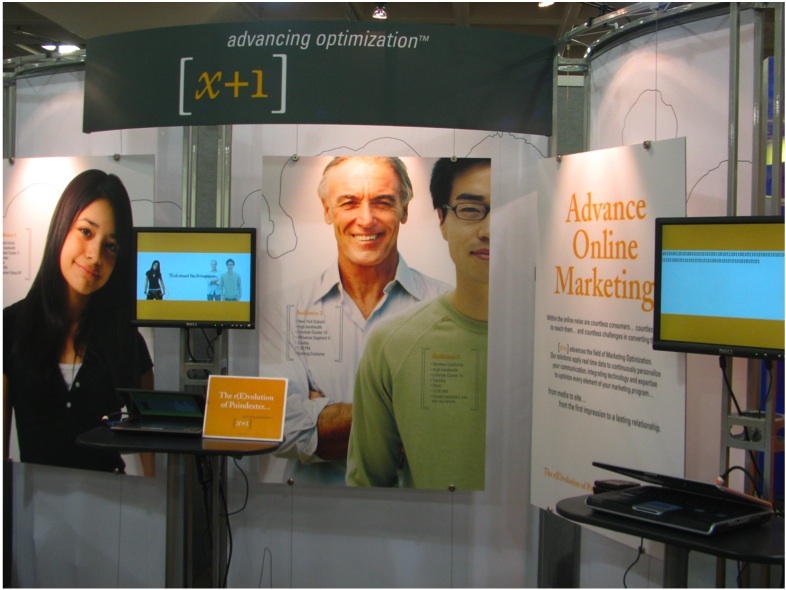
People images making eye contact draw visitors into your booth.
You can do a lot to influence traffic with the design of the booth itself. Do: allow for a seamless flow of traffic from the show floor into your booth… so people can find themselves inside your booth without expecting it. This means minimizing the use of registration kiosks that throw up a barrier. Do: use people imagery in your booth signage, especially people who make eye contact with passers by.
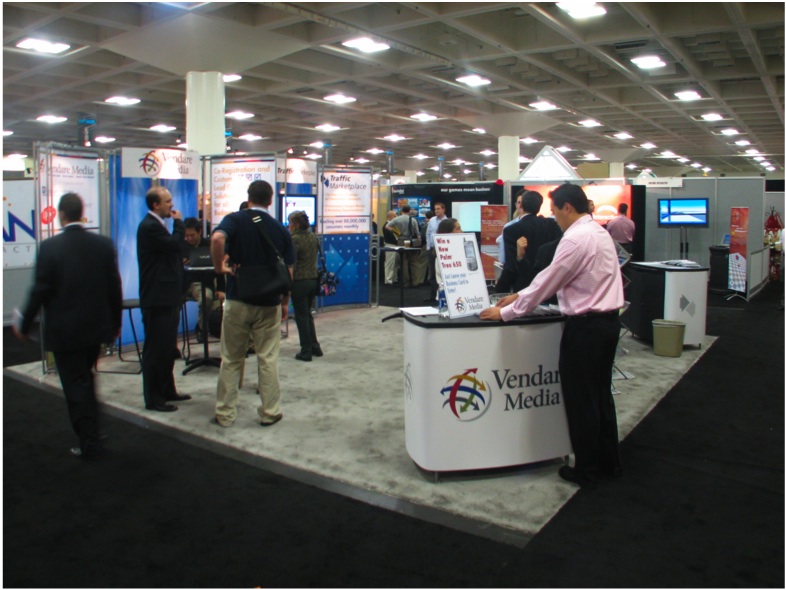
Kiosks at the corners create a "desert island" effect and make your booth look empty.
Don’t: put kiosks in the far corners of a large booth. They create a desert island effect, making your booth look empty even when it isn’t. And especially don’t: put up walls or barricades of any kind that people have to pass through to get into the booth. They simply won’t do it and your trade show will be an unsuccessful and lonely experience.
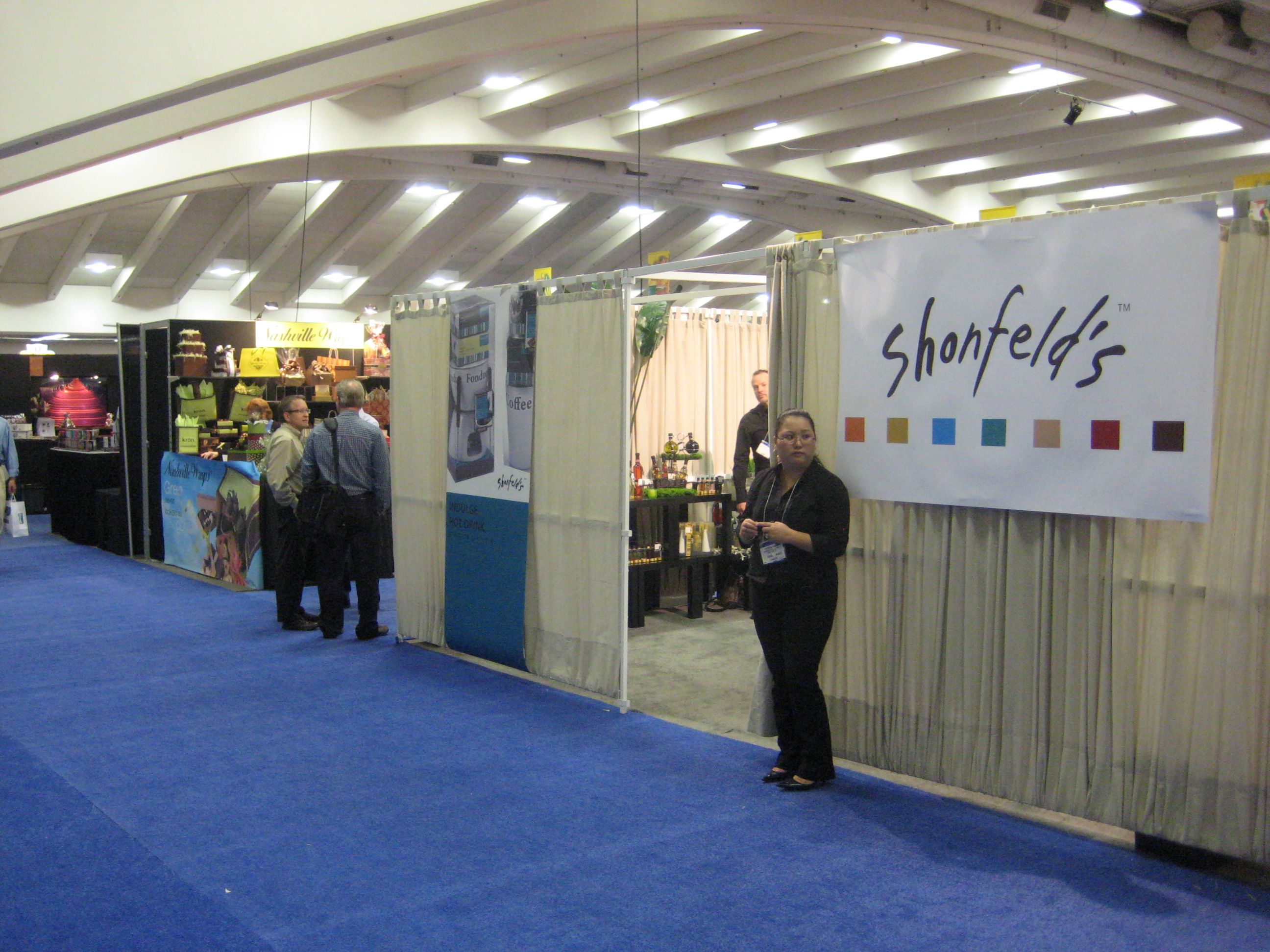
Double bad: a gatekeeper plus a fabric wall ensures this booth will stay empty.
You can also build traffic prior to the event by inviting customers, prospects whose contact information you have collected, and possibly registered attendees (depending on how much it costs you to use the list, it could be a good deal or not) to come to the booth and get something specific with solid perceived value: a new research report on trends in your industry, for example. Don’t invite them just to check out your new product line, that’s not a strong enough call to action. A drawing or bring-this-postcard-for-a-free-gift will also work, though as with other soft offers this means more response but less quality.