Tomorrow I head west for this year’s Consumer Electronics Show in Las Vegas. The word is that LAS is packed, hard to get a taxi or a hotel room just like in the glory days. I’ll be attending press events on Thursday and Friday night, visiting a couple of clients, and trolling the floor for new and noteworthy things to write about.
In last year’s preview post (inexplicably titled “On my way to CES 2009″) I talked a little about my philosophy of working this show. I also predicted that 3D TV would be a non-starter… you read it here, and many other places, first. This year is supposedly “the year of the tablet” which also happened in 2003; I am more interested in things you can do with the tablet, such as iGrill, the world’s first bluetooth cooking thermometer you can monitor from your iPad.
My task on the plane is to scan some 300 press release emails and see if there is anything promising enough to follow up. Tip to flacks: like most people who will be writing about the show, I’ve been filtering my CES emails into a special folder. So if you don’t say “CES” in the subject line, you’re not visible to us.
Wearing my consumer hat, I am going to find what the ^% is happening with the content side of streaming video. Was excited to get an HD Roku for Christmas. Not so excited to discover that Netflix has just 20,000 streaming titles available, NOT including anything by the Coens, or Dumb and Dumber, or the Southland series from TNT. I’ve read that the studios seriously underestimated the appeal of streaming and delivered their content to Netflix at a bargain price, but if they’re going to just pull it back then we don’t have a seamless entertainment experience, do we?
Bing is the Mac OS of the search world. (Yep, that’s ironic.) It only has a small market share, but those users have become so loyal that it has to be considered in any search marketing plan. Succeeding against all odds when other search engines were becoming an afterthought, Bing did it the same way as Google: an innovative software algorithm.
Now, Bing is taking on another Google property with its enhanced Streetside which was introduced at CES 1010. This is like Google Maps combined with Google’s directory features, but with more information and better organized. If you’re looking at a restaurant, for example, you can see ratings from a variety of sources and an aggregate quality score.
Yet what is most cool is the Photosynth feature, which allows multiple users to contribute their own visuals of a landmark which are then stitched together to enable a 3D view that can be much more information-rich than Google’s Streetview. For a heavily documented site, like the Rome Coliseum in the example, you can zoom in on a detail and do a virtual walkaround.
I shot a video with a demo of Streetside by a Microsoft boother. The really cool stuff, demoing Photosynth, is toward the end.
foneGEAR's non-booth. Some teaser signage on those mirrored walls would have helped.
Can you create buzz at CES without showing any product? A couple of companies tried exactly that. First up is a company called foneGEAR. They decided sometime before the show to completely revamp their product line and positioning so, rather than show their current product, they elected to turn their large and expensive booth into a giant “coming soon” sign. The curious were funneled down a mirrored passageway where a single booth rep swiped their card and gave them a key code to unlock a product preview on their website. Booth traffic was pretty light… it might have been a good idea to put a few teaser messages on those long blank walls.
The case of PowerMat is more interesting. Their booth was jammed on Friday and I couldn’t get a demo because they were tied up with Good Morning America. All this with no product on display, just a loop of TV commercials in which hipsters place their iPhones and other portable devices on a pad and it goes bzz! and starts charging. Wireless charging, that’s cool!
But since I didn’t get the demo I read up in the press kit, and discovered PowerMat’s secret: you can’t just fling the device down, it has to be in a special inductive power sleeve that’s not obvious in the commercials. And early users and reviewers have lots of complaints like: it’s hard to get the sleeve on and off; it’s too bulky; it interferes with the compass in the GPS.
All hat, no cattle? PowerMat booth at CES.
I returned Saturday and asked a booth staffer why they aren’t exhibiting product. (Meanwhile, traditional media guys are circling waiting for their demos like hungry sharks, sensing they’re really onto something. After all, everybody knows the pain of plugging in to charge your phone. Oh, to be free!) He said they did have product out the first thing on Thursday and there was such a mad scramble for it they put it away.
Now, this isn’t a stealth product. You can buy it at Amazon and Best Buy. I’ll take him at face value, even though creating mystery around a buggy product rather than showing seems like a pretty cool marketing strategy. Pay no attention to that man behind the curtain..
Yesterday at CES I got a demo of a soon-to-be-released product aimed at parents concerned about their kids. There are two modules. Mobile Protector is a phone app they receive along with their first mobile phone. It allows the parents to control what numbers they dial and receive, whether or not they can text and under what restrictions. If they like, the parents can serve as a switchboard: incoming calls come to them and they can answer, decline or forward to their kid’s phone.
When the child reaches driving age, a vehicle mounted console called Driver Protector is added. Parents will now know where the young driver is at all times and they can set up a “Geofence” to be sure the kids are staying within an approved area. If the kid strays, or texts while driving, the phone can shut down automatically. They can tell if the kid is driving too fast, and if they are in an accident there is an alert triggered by sudden deceleration or the deployment of an air bag.
Mobile Protector demo at CES. Afterward, a woman from the audience allowed herself to be tased for our amusement.
The interesting thing is that these products have been developed and will be released by Taser. Yeah, that Taser. I asked the booth guy how this fit with the weaponry and he said Taser’s motto is “protect life”—as in, using our product will help you protect the things in life that matter; as in, if you mess up we’ll tase you but hopefully not kill you.
I see this cutting two ways in the marketplace depending on how it’s marketed and received. Best case is that kids think it’s cool: mom and dad have given me my own Taser, sorta, to keep me safe. Worst case is they think it’s an onerous form of parental subjugation. Let’s see how it plays out.
This year I pre-registered as a blogger at CES, and as a result I’ve received hundreds of press announcements via email over the past couple of months. Coincidentally, I was reading the just-released new edition of David Meerman Scott’s The New Rules of Marketing and PR
on the plane coming out. Scott’s premise is that the internet has changed public relations because, instead of hawking their message to the media, businesses can now promote themselves by speaking to the public directly—via blogs, content on their own website, posts and responses on networking sites and viral media.
I did an evaluation of the PR emails I’d received with this in mind. The pitches that grabbed me were the ones that were written like news stories and tied to a course of action I could take at CES to find out more and bring it to my own readership. Find out why Apple is up but Sony dropped seven spots in the Greenpeace rating of green manufacturers. Team up with Dr Dre, Lady Gaga and Monster to fight AIDS in Africa. See how Natralock ends “wrap rage” with the end of hard-to-open clamshell packages.
The interesting thing is, many of these are the kind of made-up stories or manufactured events that used to be easy to make fun of: a marketer whipping up fake news because they couldn’t find a legitimate product benefit. Now I’m reading them as a recipient of information, not a conduit, and they become relevant. I’m eager to blog about it and add my own spin, and then the flack’s work is well rewarded.
By comparison, landing side by side in the inbox, traditional press releases just didn’t cut it. (“FOR IMMEDIATE RELEASE: La Cie announces new server for business.”) And some of the senders show a lack of finesse in using email as a medium. No-nos in my book include emaiing the press release as an attachment rather than including it in the body of the email (with this sea of info, why would I take an extra step to read your release?); addressing me as your bud because, you know, it’s email (e.g. starting with “hope all is well” or “hope you had a good holiday”); and sending a graphics-heavy announcement without ALT tags which is basically illegible unless I download the visuals (I’m looking at you, Vizio).
Scott’s theory is that there is a huge sea of traditional flacks who are trying to hang on or just don’t get it, and I guess this would be evidence. Meanwhile, I’ve got a couple of upcoming posts in the hopper, based on those pre-show emails I received.
Just finished my first day at the 2010 Consumer Electronics Show. The aisles are packed, at times so much so you can’t get through. But there are no exhibits in the huge Sands center this year, several of the areas in the back of the South Hall are blocked off, and one of the ballrooms usually used for the Hilton International pavilions is dark. In the main hall, OEM no-names share the prime spots with the likes of LG and Panasonic. My guess is that exhibitors panicked and stayed away while significantly more attendees are here than last year, signaling their intent to lift us out of our gloom.
According to show sponsor CEA, consumer electronics sales were off 7.8% in 2009 yet with higher volume led by bargain hunters. Sales for 2010 are projected to be up “slightly” from this terrible level. So it was interesting to see what attracted the most attention at the show.
Most popular trend that is going nowhere: 3D TV. Everybody is standing in lines to get into the theater rooms and see it but my prediction is, this is like the hot girl you’re never going to bring home to meet mom. Once the 3D glasses get stepped on or lost in the couch cushions, the party is over. (One vendor, TCL, shows a Fresnel lens type 3D where the picture is slightly different as you sift your vision, and doesn’t require glasses, but it doesn’t really have the drama of the polarized glasses kind.)
Bad news for the 3D TV folks: virtually no traffic in the zone promoting mobile TV, a technology that is designed to provide high quality reception in a moving vehicle. If you don’t want your kids to watch live TV in the car, my prediction is you won’t want to watch 3D at home either. There’s a limit to how much fun you can have.
Entourage Edge gives you the best of both worlds. It’s an e-reader AND a tablet computer.
Attracting a lot of crowds: e-readers. Diverse interpretations and executions of what Kindle left out, many with added value content such as newspaper subscriptions, complete with graphics, delivered along with your e-books. There was prediction Apple would show its new tablet at the show, but I haven’t seen it. (SF pundits mention Moscone Center is mysteriously unbooked for several days in late January, suggesting an Apple stealth event coming then.)
I saw several specific technologies of interest. Will report on some of these tomorrow.
This is my first year as an “official” blogger at CES (why the quotes, dude?). I’m already a day late because many of the press events are held on Thursday so they can get coverage before the throngs arrive. Definitely sorry to miss Lady Gaga at the Monster booth. Wonder if I’ll run into her later tonight when I arrive, maybe at the Showstoppers Expo?
The first time I attended this show was before many of my readers were born, probably, back in the 80s. I was an account exec at an agency representing The Federated Group, a home entertainment chain that has since gone to its reward. Accommodations were incredibly hard to find pre-internet efficiency. I was put up at the Showboat, somewhere downtown and far from the action. It was all demos of Betamax and Quadraphonic. I did not have fun.
Today the CES incorporates many of the vendors who used to be at COMDEX and they’re primarily my focus in attending. As a marketer, I like to hang back in demos and watch my audience to see what questions they have and what bullet points make their eyes light up (or become less glazed over). I also like to look for new or interesting technology which often comes not from startups (it’s very expensive to exhibit here) but from backwaters divisions of major companies—Panasonic’s heat pump washer/dryer, covered last year, being a good example.
And, as a marketer I like to look at the way all these companies are marketing themselves. If you’re into home entertainment, how do you establish through your booth display that your product is “entertaining”? If it’s a new technology, how do you show in a microsecond what it does? Now that I’m on the press list I get to see lots of flackery, good and bad, in the press releases and invites sent out. Most intriguing so far is Gracenote’s display at the Showstoppers tonight, which promises only “surprises”. Hope I am. More later.
When air is compressed it gets hot. When it expands, it cools off. Add some kind of fan to circulate the hot and cold air and you have a heat pump—the technology behind refrigerators, air conditioners, home heating systems for some environments (where there is a considerable difference between the ambient temperature in two different places, e.g. the ground and the air)…. and now, washer/dryers.
Panasonic demonstrated this unit at the 2009 CES. I took a movie of it which is here, on YouTube. (sorry for all the noise… it’s CES!) Unfortunately, there are no plans to import this device to the US because the capacity is too small.
Advance registrations at the Consumer Electronics Show were down 5-7%, but the real question, since most industry folks get in free, was how many would actually show up. Good news. Floor traffic is fine and it’s too packed to move in many places, just like regular years.
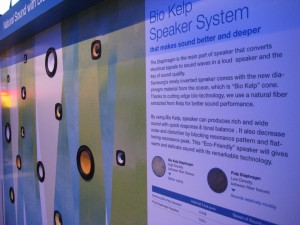
Environmentally-sensitive kelp speakers, from Panasonic
Most interesting for me from a marketing perspective were the home monitoring systems, including one from client Schlage locks. Via a low-power wireless mesh network you can lock and unlock your doors, turn lights on and off, and regulate your home entertainment system. With an extra subscription you can log on remotely and see if your kids got home on time (because each family member has their own code to unlock the front door), if you remembered to close the garage door, or preheat the oven. And because every product has to have an environmental angle this year, these systems also have energy components that can dim your lights when you leave the room or turn off the power if you forget.
A few other items of interest:
Finally, a flat screen TV that actually is as thin as a sheet of glass, from LG.
3D televisions, complete with 3D goggles, were everywhere. My favorite was LG again, maybe because they had the best movie playing (a scary Korean animation about a kid, a robot, and a nuclear winter).
Minoru, The world’s first 3D webcam and Sergio iSpin, a sophisticated DJ remix station for your iPod, both not prototypes but selling right now for under $100 on Amazon.
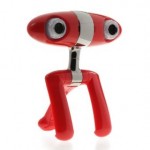
Minoru, the 3d webcam
Beatbot, a puffy robot containing a webcam which can be made to react to stimuli. This is used not for play but as therapy for children; they can interact with the robot directly and make it do things and the webcam can watch what they are doing and track improvements over time.
And this year’s favorite tcotchke: from Cirago, a solar powered LED keychain!
We’re coming up on January, which has become my big trade show month since the demise of Comdex. I’ll go to the Consumer Electronics Show first, followed by a quick stop at Macworld, and then the Fancy Food Show at the end of the month. What am I looking for, other than schwag and free food?
First, I want to see how companies I work with—or their competitors—get the attention of the audience through elevator pitches or booth design. And second, I want to watch other show-goers who may well be my audience at some point to see what questions they ask and what “hot buttons” cause their faces to light up. It’s also nice to put a face with abstract stats so I can have a mental image of my reader, next time I write to Dear IT Manager or whatever.
In my copywriting class we talk a little about trade show booth design for smaller companies—something that increasingly seems to be the responsibility of the marketing folks who are my students. It’s not easy to create a visual “home” out of nothing that can be erected and disassembled quickly. One thing I’ve noticed is that faces help—big photos of people who look like your users, making eye contact with the show traffic. Not enough companies do this so it’s very easy to make yourself stand out.
Also, too little attention is paid to booth traffic patterns. If you stand behind a high counter, you’re creating the metaphor of a store checkout—people will not approach unless they’re already committed to doing business, which eliminates most potential booth visitors. If you put up registration kiosks at the outside corners, or entry points framed by signs, you’ve created a boundary that may keep people out.
As a show floor troller, I tend to be wary of a big and empty booth—I assume that they don’t have much to offer and that if I go in I’m guaranteed to be hit with a sales pitch. But I find a booth with higher traffic irresistible, because I want to see what the buzz is all about. You can do this with good visual design and a seamless traffic pattern. Oh, and free samples of artisanal cheese will help.